
China Top Hybrid Flooring Manufacturers for Global Buyers
Hybrid Flooring is gaining attention among global buyers who want the look of timber with practical resistance to moisture and daily wear. China’s manufacturers offer a wide range of SPC and WPC products, but “hybrid” can describe different core structures, wear layers, and locking systems. Buyers should compare specifications, not rely on the label alone.
Grand View Research valued the global flooring market at USD 339.8 billion in 2022 and projected a 5.2% compound annual growth rate from 2023 to 2030. This figure covers flooring overall, not Hybrid Flooring alone. It signals a large, evolving market, but it cannot verify the performance of any individual supplier. Resilient Floor Covering Institute president Dean Thompson has emphasized a practical principle: choose resilient flooring according to the room’s performance needs. That advice matters. A sunlit showroom and a damp apartment are not the same test.
This guide introduces leading Chinese manufacturers for international sourcing and explains what to check before requesting samples. Look closely at wear-layer thickness, dimensional stability, locking-joint design, emissions documentation, and batch consistency. Ask for current test reports and confirm that stated results match the exact product being quoted. A polished sample is useful, but it is not proof of long-term performance. Specifications can be incomplete, and supplier claims deserve careful review. Good sourcing starts with questions.
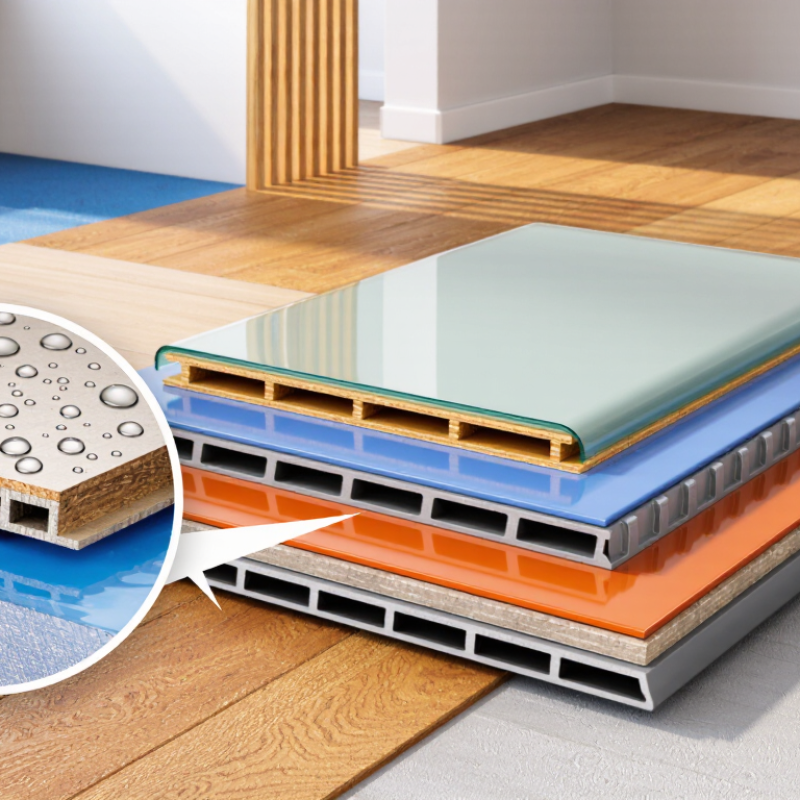
Understanding Hybrid Flooring and Its Main Product Types
Hybrid flooring combines a decorative surface, protective wear layer, and rigid composite core. The two main core types are SPC and WPC. SPC uses a mineral-filled polymer core, giving planks a dense, firm feel underfoot. WPC uses a foamed composite core, which can feel softer and warmer. Construction varies between manufacturers, so check technical sheets rather than relying on a product label alone.
The distinction matters during specification. SPC can suit busy areas where dimensional stability is important; WPC may appeal in bedrooms or living rooms where comfort matters. Neither core removes the need for a suitable, level subfloor. A 2024 Grand View Research report estimated the global resilient flooring market at about USD 40 billion in 2023. That figure covers more than hybrid flooring, so it should not be read as hybrid sales alone. Details matter. “Waterproof” describes the product, not necessarily the installed floor: seams, edges, and subfloor conditions still deserve attention. I would also compare wear-layer thickness, locking profile, and published installation limits before choosing.
China Top Hybrid Flooring Manufacturers for Global Buyers - Understanding Hybrid Flooring and Its Main Product Types
| Product Type | Typical Core Construction | Underfoot Feel and Rigidity | Dimensional Behavior | Water Performance | Common Formats | Typical Applications | Buyer Considerations |
|---|---|---|---|---|---|---|---|
| SPC Hybrid Flooring | A rigid core commonly made from PVC with mineral filler, often limestone. Exact formulations and layer construction vary by product. | Generally dense and firm underfoot. Its rigid core can help the floor bridge minor subfloor imperfections, but it does not replace proper subfloor preparation. | Usually designed to resist everyday changes in temperature and humidity better than many less-rigid flooring constructions. Performance depends on product specifications and installation conditions. | The flooring surface and core are generally water-resistant. Water can still affect joints, edges, or the subfloor if it reaches them; follow the product’s installation and maintenance instructions. | Commonly supplied as click-lock planks or tiles, with wood-look and stone-look designs. | Residential rooms and some commercial spaces, when the product’s wear layer, warranty, and installation requirements suit the intended traffic. | Check core thickness, wear-layer thickness, locking-system requirements, underlay compatibility, and permitted temperature range. A rigid core does not make every installation suitable for every subfloor. |
| WPC Hybrid Flooring | A wood-plastic composite core, typically containing polymer and wood-derived or other foaming components. Formulations differ among products. | Often feels somewhat softer or more cushioned than SPC, although the backing, underlay, and full construction also affect comfort and sound. | Its dimensional performance varies with the core formulation and product design. Follow the manufacturer’s acclimation, expansion-gap, and installation guidance. | The core and surface are commonly marketed for water resistance, but joints and the subfloor remain potential paths for moisture. Do not assume the installed floor is a waterproof barrier. | Commonly supplied as click-lock planks, including wood-look designs; available sizes and constructions vary by supplier. | Residential areas where a slightly more cushioned feel is preferred, subject to the product’s stated use and installation limits. | Compare the complete layer build-up, not core type alone. Review wear-layer details, acoustic backing, warranty exclusions, and moisture requirements for the subfloor. |
| Hybrid Flooring: Shared Construction | Typically combines a decorative layer, a protective wear layer, a rigid or semi-rigid core, and often a backing or attached underlay. The exact layer order and materials vary. | Feel and sound depend on core density, total thickness, backing, underlay, and the condition of the subfloor. | Expansion behavior is product-specific. Direct sunlight, temperature changes, large continuous areas, and installation details can affect performance. | Water resistance is not the same as a guaranteed waterproof room assembly. Protect the floor from standing water and install it according to the product instructions. | Planks and tiles are common; surface textures, dimensions, locking profiles, and edge details vary. | Choose according to room use, expected traffic, cleaning practices, and the manufacturer’s approved installation locations. | For a fair comparison, request technical data for wear layer, total thickness, core type, slip performance where relevant, fire classification, emissions, warranty, and test methods. |
Terminology note: “Hybrid flooring” is used differently across markets and suppliers. SPC and WPC are common rigid-core categories, but product composition, performance claims, and test results should be verified against the individual product’s technical documentation.