
How to Choose the Best Industrial Fans for Your Business?

Choosing the right Industrial Fans can shape workplace comfort, equipment life, and long-term operating costs. A crowded workshop may need steady air movement, while a warehouse could require high-volume circulation across tall storage racks. The best choice depends on more than motor size. Room dimensions, heat sources, dust levels, humidity, noise limits, and ventilation goals all matter.

A reliable selection process begins with measured conditions. Record the floor area, ceiling height, indoor temperature, and available power supply. Then compare airflow ratings, static pressure, motor efficiency, blade design, controls, and safety features. Experienced engineers can help match fan performance with the building’s actual demands, rather than relying on attractive catalog figures. Certification, warranty coverage, spare-part access, and maintenance support also deserve close attention. Small details matter. A poorly placed fan may create turbulence instead of useful cooling. An oversized model may waste energy and increase noise. There is no perfect fan for every facility. Even a technically sound recommendation may need adjustment after installation, because real airflow rarely behaves exactly like a drawing. Testing air movement near workstations, checking vibration, and reviewing energy use can reveal those gaps. This guide explains how to evaluate Industrial Fans with practical evidence, professional judgment, and realistic expectations. The goal is not the most powerful unit. It is dependable airflow that supports people, processes, and budgets.
How to Choose the Best Industrial Fans for Your Business?

Industrial Fan Types and Their Best Business Applications

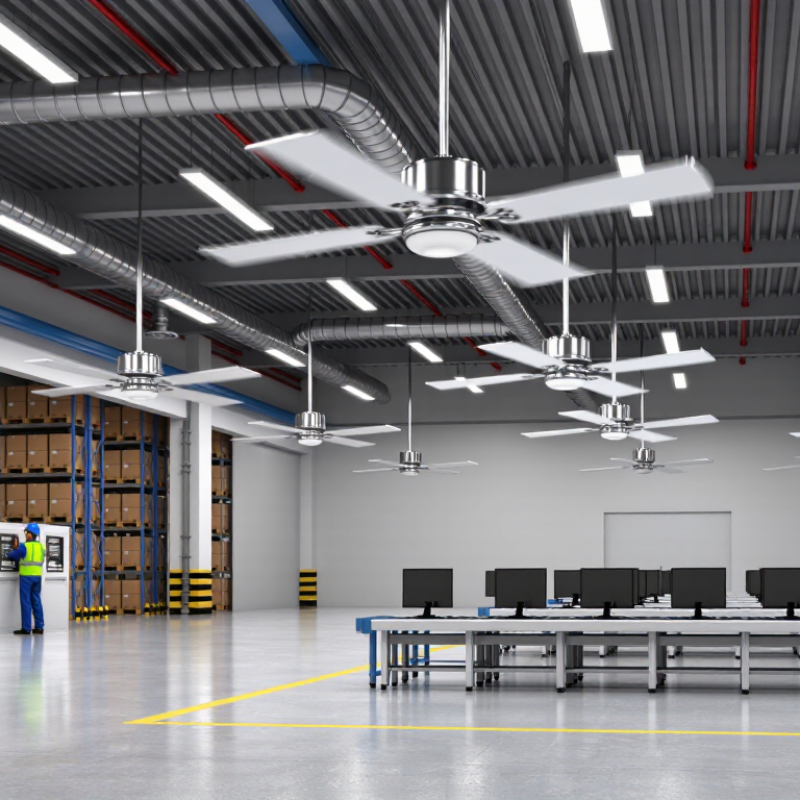
Choosing an industrial fan starts with the work area, not the fan catalogue. Axial fans move large air volumes at relatively low pressure. They suit warehouses, workshops, and production floors that need general ventilation. Centrifugal fans generate stronger pressure for ducted systems, filters, and fume extraction. They are useful when air must travel through long or narrow routes. High-volume, low-speed fans cover broad floor areas with gentle airflow. They fit distribution centres, gyms, and livestock buildings.

Match the fan to the application. A welding area may require local extraction near the source, rather than whole-room circulation. A hot factory line may need focused cooling around operators and equipment. Dusty environments demand suitable filtration and accessible inspection points. Fans handling heat, moisture, or corrosive vapours need materials and motors rated for those conditions. Check airflow, static pressure, temperature range, noise, and duty cycle before buying.

Measure the space carefully. Door openings, roof height, and existing ducts can change performance. A fan that looks powerful may disappoint if system resistance is ignored. That mistake is common. Also review guards, emergency controls, cleaning access, and energy use with a qualified technician. Maintenance records should show bearing checks, vibration observations, and airflow changes. Real conditions are rarely perfect, so allow adjustment capacity instead of selecting the smallest possible unit.

How to Choose the Best Industrial Fans for Your Business?

Industrial fan selection depends on the system's required airflow and static pressure. The chart compares typical static-pressure operating ranges for major industrial fan types and highlights their most suitable business applications.

Typical ranges are indicative engineering values and can vary according to impeller design, fan size, speed, filters, ductwork, and operating conditions. Axial fans are generally suited to high-volume, low-pressure ventilation, while centrifugal fans are preferred for higher-pressure systems with duct resistance.

Key Factors for Matching Fans to Your Facility’s Needs

Choosing an industrial fan starts with the facility, not the catalogue. Walk through the space and note heat zones, dust, humidity, ceiling height, and worker locations. Airflow is not everything. Measure twice. A production area with welding fumes needs controlled exhaust, while a warehouse may need broad, gentle circulation. Record the required air changes and target temperature with a qualified engineer. Guessing can create noise, dead spots, or unsafe pressure differences.

Match fan capacity to the building’s resistance. Ducts, filters, louvers, and screens reduce delivered airflow, even when the motor rating looks impressive. Ask for performance data at the required static pressure, not only a free-air figure. Check motor efficiency, speed control, enclosure rating, and operating temperature. In dusty areas, maintenance access matters as much as efficiency. A technician should be able to clean blades and inspect bearings without blocking a production aisle.

Noise and comfort deserve a site-specific review. A powerful unit near an office can make conversation difficult, while a poorly placed exhaust fan may pull conditioned air outdoors. Verify electrical supply, mounting strength, emergency controls, and local ventilation requirements before installation. Leave room for future process changes. That part is often missed. Test airflow after commissioning with an anemometer, then compare readings against the design target. If results disappoint, document the gap instead of hiding it; the fan, layout, or original assumptions may need revision.

How to Compare Airflow, Pressure, Efficiency, and Noise Levels

How to Choose the Best Industrial Fans for Your Business?

Airflow is only half the selection problem. Compare the required volume in m³/h with the system’s actual resistance, measured in Pa. A fan delivering 20,000 m³/h at free air may provide far less through filters, ducts, dampers, and bends. AMCA Publication 203 explains why fan curves must be read at the operating point, not at the maximum airflow. I would also check the system effect factor. Small duct changes can alter performance.

Pressure matters.

Efficiency should be compared at the same duty point. Total efficiency includes aerodynamic and motor losses, giving a more realistic operating picture. The U.S. Department of Energy’s Improving Fan System Performance sourcebook highlights system resistance and proper control as major energy considerations. Fan laws also show a practical warning: airflow changes with speed, pressure changes roughly with speed squared, and power changes roughly with speed cubed. A modest speed increase can become an expensive mistake.

Noise needs a separate check. Compare sound power levels, octave-band data, and the distance used for sound-pressure measurements. A single dBA number can hide irritating low-frequency tones.

NIOSH recommends limiting occupational noise exposure to 85 dBA over an eight-hour shift, while OSHA permits higher limits under specific conditions. Local rules still matter.

My first-pass choices often focused too heavily on airflow. That shortcut failed when workers stood beside the outlet. Temperature, maintenance access, and actual filter loading deserve another review.

Selecting the Right Fan Materials, Features, and Safety Standards

How to Choose the Best Industrial Fans for Your Business?

Selecting the right fan begins with its environment. Steel suits hot, abrasive areas, while stainless steel resists moisture and chemical corrosion. Plastic composite housings can reduce weight, but they may require careful temperature limits. The U.S. Department of Energy reports that fan systems can represent about 15% of industrial electricity use. A small efficiency mistake becomes expensive.

Check airflow, static pressure, operating temperature, and duty cycle together. Variable-speed drives can reduce energy use when demand changes, although poor control settings can create unstable airflow. The Air Movement and Control Association recommends standardized testing for fan performance, including airflow, pressure, and power measurements. Ask for certified test data, not only a catalog headline. Numbers can look impressive.

Safety deserves equal attention. Confirm guarding, emergency stopping, motor protection, noise exposure, and maintenance access. OSHA machine-guarding guidance requires protection from exposed moving parts in applicable workplaces. For explosive atmospheres, equipment may need certification under IEC 60079 requirements. Local rules still matter. A corrosion-resistant fan may fail early if its fasteners are ignored. I have seen specifications focus on the impeller while overlooking bearings, seals, and cleaning space. That is a costly blind spot. Recheck the selection after installation, using measured airflow and motor current.

Installation, Maintenance, and Total Cost of Fan Ownership

Choosing an industrial fan requires more than comparing purchase prices. Installation errors can increase noise, vibration, and energy use. Mounting alignment matters, especially when ductwork creates uneven airflow. Leave service clearance around bearings, belts, guards, and electrical connections. A commissioning test should record airflow, static pressure, motor current, and operating sound.

The International Energy Agency reports that electric motor systems consume about 53% of global electricity. Fans are only one part of that demand, but inefficient control can raise operating costs every hour. Variable-speed control may reduce power sharply when airflow needs change. Maintenance should include belt tension checks, impeller cleaning, bearing inspection, and vibration measurements. In my experience, neglected dust buildup is easy to underestimate. It can quietly reduce performance before failure becomes obvious. Total ownership cost includes electricity, filters, labor, downtime, replacement parts, and disposal.

Tips: Request a duty-point test, not only a catalog rating. Compare projected energy use over five years. Record vibration trends monthly. Keep spare belts and critical sensors on site. The U.S. Department of Energy’s fan-system guidance recommends examining system resistance and control strategies, not just motor efficiency. That advice deserves attention. A cheaper fan may become expensive when access is poor, controls are oversized, or maintenance requires production shutdowns. Allowing for uncertainty is wiser than trusting one perfect spreadsheet.

How to Choose the Best Industrial Fans for Your Business? - Installation, Maintenance, and Total Cost of Fan Ownership

Fan Type Typical Applications Typical Airflow Range Typical Static Pressure Common Motor Rating Installation Requirements Routine Maintenance Expected Service Life Relative TCO Profile
Axial Fan General ventilation, warehouses, workshops, and heat removal 5,000–120,000 m³/h 50–500 Pa 0.37–15 kW Requires a clear inlet and outlet path; wall or roof mounting may require structural support and weather protection Clean blades and guards; inspect bearings, fasteners, vibration, and electrical connections 8–15 years under suitable operating conditions Low to medium purchase and installation cost; economical for high airflow at low pressure
Centrifugal Fan Ducted systems, dust collection, process ventilation, and high-resistance systems 2,000–80,000 m³/h 500–3,000 Pa 0.75–75 kW Needs a correctly sized base, aligned ductwork, access clearance, and flexible connectors to limit vibration transfer Inspect impeller balance, belts or couplings, bearings, casing, filters, and duct pressure losses 10–20 years with proper alignment and lubrication Medium initial cost; may deliver lower operating cost in high-pressure applications
Mixed-Flow Fan Compact ventilation systems requiring moderate airflow and pressure 3,000–50,000 m³/h 300–1,500 Pa 0.55–30 kW Requires stable mounting, adequate service access, and duct transitions designed to minimize turbulence Check impeller cleanliness, bearings, vibration, fasteners, and motor temperature 8–15 years Medium total cost when space and moderate pressure requirements are important
Roof Extractor Fan Building exhaust, heat removal, odor control, and general industrial ventilation 2,000–40,000 m³/h 100–800 Pa 0.25–15 kW Requires roof curb compatibility, waterproof flashing, safe roof access, and protection against wind and weather Inspect weather seals, roof curb, motor, bearings, guards, and debris accumulation 8–15 years depending on exposure and corrosion protection Low to medium installation cost can increase when roof reinforcement or difficult access is required
High-Volume Low-Speed Fan Large warehouses, distribution centers, aircraft hangars, and livestock buildings 20,000–150,000 m³/h 20–150 Pa 0.75–5.5 kW Requires verified roof or ceiling load capacity, fall protection, adequate clearance, and a controlled air distribution layout Inspect blades, suspension cables, gearbox or direct-drive motor, controls, and mounting hardware 10–20 years with scheduled inspections Low operating cost for large open spaces; effectiveness depends on ceiling height and layout
Explosion-Protected Fan Areas with flammable gases, vapors, combustible dust, or hazardous process atmospheres 1,000–40,000 m³/h 200–2,000 Pa 0.37–30 kW Requires hazardous-area classification, compliant electrical equipment, bonding and grounding, and installation by qualified personnel Documented inspections, grounding checks, corrosion control, bearing checks, and verification of protective devices 10–20 years when operated within certified limits High initial cost; safety compliance and risk reduction are primary selection factors
Portable Industrial Fan Temporary ventilation, confined-space work, maintenance areas, and emergency air movement 1,000–20,000 m³/h 100–1,000 Pa 0.25–7.5 kW Requires stable placement, protected power supply, suitable extension leads, and safe routing of flexible ducting Clean guards and impellers; inspect wheels, cables, switches, duct connections, and impact damage 5–10 years depending on mobility and operating environment Medium to high operating cost if used continuously; flexible for changing work areas
Planning note: The ranges above are typical engineering estimates for general industrial equipment, not guaranteed performance values. Final selection should be based on required airflow, system pressure, air temperature, contaminants, operating hours, noise limits, electrical supply, hazardous-area classification, and applicable local safety standards.
Installation Cost Drivers:
Structural support, ductwork, electrical work, lifting equipment, access requirements, weather protection, and commissioning.
Maintenance Cost Drivers:
Operating hours, dust loading, corrosion, bearing type, belt replacement, filter condition, accessibility, and spare-part availability.
TCO Calculation:
Total cost of ownership = purchase price + installation + electricity + planned maintenance + repairs + downtime and disposal costs.