
How to Choose the Best Stainless Steel Sink?

Choosing a Stainless steel sink is not just a finish decision. It affects daily cleanup, counter space, noise, and how well a kitchen handles years of use. Houzz’s 2024 U.S. Kitchen Trends Study found that 81% of renovated kitchens used undermount sinks. That figure describes installation style, not sink material, but it shows how strongly fit and countertop design shape buyer choices. A sink can look perfect in a showroom and still feel awkward beside a tall faucet or a narrow cabinet.

Material and construction deserve equal attention. Many residential models use 304 stainless steel, often described as 18/8 steel. Yet alloy grade alone does not tell you how the sink will perform. Compare bowl depth, corner shape, finish, mounting method, and the manufacturer’s warranty. Check the cabinet opening, too. A deep bowl may hold a stockpot, but it can reduce usable space below. Thicker steel can feel sturdier, though gauge labels can confuse buyers because lower gauge numbers generally indicate thicker material. Small details matter. Drain placement, sound-dampening pads, and a satin finish can change everyday use. No option is perfect. The best choice balances your cooking habits, installation limits, budget, and tolerance for visible water spots.
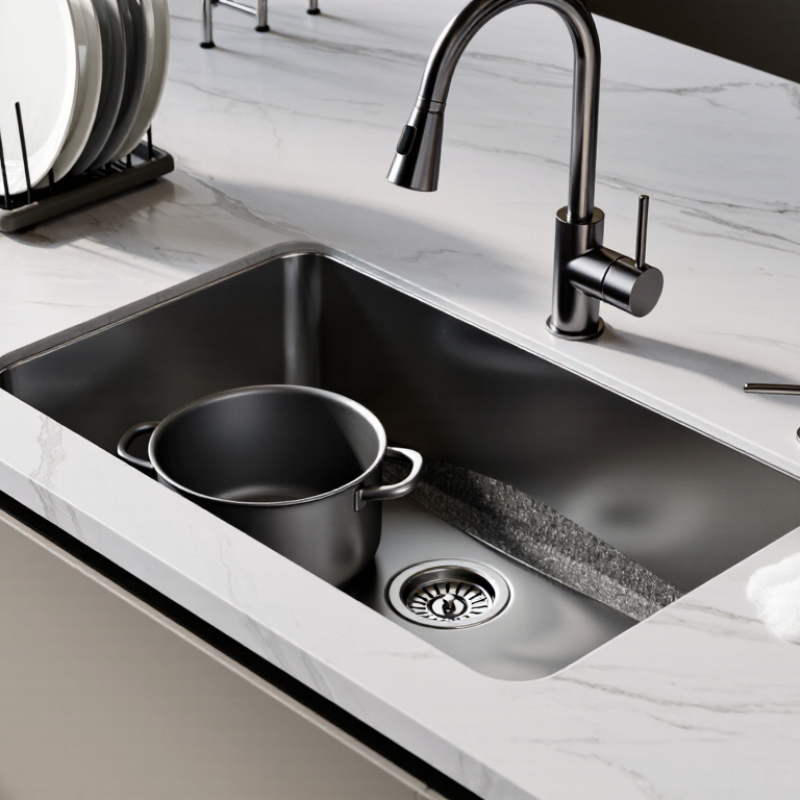
How to Choose the Best Stainless Steel Sink?

Assess Your Kitchen Layout and Sink Requirements

Before comparing stainless steel finishes, map the sink to your kitchen’s actual workflow. Measure the cabinet opening, countertop depth, and space beneath the bowl, including plumbing and waste bins. Then note where food is washed, chopped, and served. A sink far from the prep area may turn a tidy kitchen into a drip trail.

Bowl shape should match daily tasks, not just appearance. Houzz’s 2023 U.S. Kitchen Trends Study found that 67% of renovating homeowners chose a single-bowl sink, while 77% selected an undermount installation. Those figures describe surveyed renovators, not a rule for every kitchen. A wide single bowl can fit baking trays, but it may leave no separate place for rinsing. Double bowls help divide tasks, though large pans can feel awkward. Measure your biggest pan.

Check faucet reach, window clearance, and whether the sink sits beside a dishwasher. A deeper basin can reduce splashes, but it may strain shorter users or crowd storage below. Small details matter.

If you hand-wash often, reserve counter space for draining; if not, an oversized sink may simply consume useful prep area. It is easy to overvalue capacity on a showroom floor. Mark the proposed dimensions on cardboard at home, then see how they affect your movements.

Compare Stainless Steel Grades, Thickness, and Durability

Stainless steel grade affects corrosion resistance, while thickness influences how solid a sink feels. ASTM A240/A240M lists Type 304 with 18–20% chromium and 8–10.5% nickel. Type 316 contains 2–3% molybdenum, which improves resistance to chloride-related corrosion. This can matter in coastal kitchens or where salty water often sits in the basin. For many indoor kitchens, 304 is a practical choice; 316 is not automatically worth the extra cost.

Thickness labels can be confusing. Compare the stated measurement in millimeters, not gauge alone. As a practical buying benchmark, consider steel around 0.8–1.0 mm thick, then inspect the rim, bowl corners, and drain opening. A heavier sheet may resist dents better, but thickness alone cannot guarantee durability. Poor forming or weak support can still make a sink flex. Sound pads can soften a hollow ring; they do not strengthen the steel. Scratches happen.

Tips: Ask for the grade and thickness in writing. Check the underside coating for even coverage, and feel around the drain for sharp edges. I would not judge a sink by weight alone; installation support matters too.

Choose a Sink Size, Bowl Configuration, and Mounting Style

A sink should fit the way you cook, not just the available opening. Measure the cabinet’s interior width, depth, and height, then check the countertop cutout requirements. A deep bowl can hold stockpots, but it may feel awkward if you are short or have limited under-sink storage. Measure carefully. Leave room for the faucet and backsplash, too; these are easy details to overlook.

Choose a single bowl for large baking trays, roasting pans, and fewer dividers to clean. A double bowl can separate washing from rinsing, or keep vegetables away from soapy dishes. Yet two small compartments may not fit a wide pan comfortably. Think about the dishes you use most often. If you rarely hand-wash, a second bowl may take up space without earning it.

Mounting style affects both appearance and cleanup. An undermount sink creates a smooth edge, so crumbs can be wiped directly into the bowl, but it needs a countertop that supports that installation. A top-mount rim rests over the counter opening and can suit more surfaces, though food may collect around the edge. Small details matter. Check the cabinet, countertop material, and installation instructions before deciding; a style that looks simple in a photo may require more work in your kitchen.

How to Choose the Best Stainless Steel Sink? — Choose a Sink Size, Bowl Configuration, and Mounting Style

Compare typical sink dimensions, bowl layouts, and installation styles to find an option suited to your cabinet, countertop, and everyday kitchen tasks.

Selection Factor Common Options Typical Dimensions or Requirements Best For What to Check Before Choosing
Overall sink size Compact, standard, or large Common overall widths are approximately 20–24 in. for compact sinks, 25–30 in. for many standard models, and 31–36 in. for larger models. Front-to-back dimensions commonly range from about 18–25 in. Compact sinks suit smaller kitchens; larger sinks provide more room for cookware and food preparation. Measure the available countertop and cabinet opening. Check the manufacturer’s cutout dimensions rather than relying only on the overall sink size.
Single bowl One large, uninterrupted basin Often available in widths of approximately 24–36 in.; usable bowl dimensions vary by model. Washing large pots, baking trays, and bulky cookware; kitchens where a flexible open basin is preferred. Confirm that the bowl’s interior width and depth can accommodate your largest cookware and that the sink will fit the cabinet.
Double bowl Two basins, often equal-sized or with a larger and smaller bowl Commonly found in sinks around 30–36 in. wide. Individual bowls are narrower than a single bowl of the same overall width. Separating washing and rinsing, or keeping food preparation apart from dishwashing. Check each bowl’s usable dimensions. A center divider can make large pots and trays harder to wash.
Low-divider double bowl Two basins separated by a divider lower than the sink rim Overall widths and bowl layouts vary; compare the divider height and each bowl’s depth on the product drawing. People who want two work areas while retaining more clearance for larger cookware than a full-height divider may provide. Verify that the lower divider still provides enough separation for your preferred washing tasks.
Top-mount (drop-in) Sink rim rests on top of the countertop Fits a countertop cutout sized to the sink’s installation template; the visible rim covers the cut edge. Many countertop types and replacement projects where a straightforward installation is desired. Confirm rim coverage, cutout dimensions, faucet-hole layout, and countertop compatibility.
Undermount Sink attaches beneath the countertop Requires a precisely finished countertop opening and a compatible, sturdy countertop material. Creating a smooth counter-to-sink transition that makes it easy to wipe crumbs into the basin. Check countertop compatibility, support requirements, edge finish, and whether the sink’s mounting hardware is suitable for the installation.
Flush or integrated mount Sink is installed level with the countertop, where the system allows Requires close coordination between the sink, countertop cutout, and installation method; availability depends on the countertop and sink design. A streamlined surface with minimal height difference at the sink edge. Confirm that the sink and countertop system are designed for this installation and that the fabricator can meet the required tolerances.
Stainless steel construction Different steel specifications, finishes, and sheet thicknesses Check the product’s stated steel grade and thickness; thickness is commonly listed in gauge, and a lower gauge number generally indicates thicker steel. Households seeking a corrosion-resistant, widely available sink material that is relatively easy to clean. Compare the stated material specification, finish, sound-dampening features, care instructions, and warranty terms. Avoid choosing by gauge alone.

Measurement note: Dimensions and cabinet requirements vary by sink design. Before purchase, measure the cabinet interior, countertop space, plumbing location, and existing cutout, then confirm the exact installation template and minimum cabinet size for the selected sink.

Evaluate Finish, Noise Control, and Practical Features

A sink’s finish affects more than its appearance; it changes how everyday marks show. Brushed stainless steel tends to soften tiny scratches and water spots, while a polished surface reflects more light. Neither stays spotless. Check the grain under bright light, and wipe a sample in both directions; streaks can appear when cleaning against the grain. Choose a finish that fits your cleaning habits, not only a showroom display.

Noise control depends on the sink’s construction and installation. Sound-dampening pads beneath the bowl can reduce the sharp clatter of dishes, while an undercoating may help limit drumming and condensation. Compare how much of the underside is covered, rather than relying on a vague “quiet” label. Even good padding cannot make a steel basin silent. A quick tap can reveal a hollow ring, though it is only one clue.

Practical details shape daily comfort. A deeper bowl can hide dishes from view, but may require more bending; measure cabinet clearance and consider who uses the sink. Rounded corners are easier to wipe than tight corners, though personal preference matters. Check drain placement against your usual washing area, and see whether a strainer or drying rack fits without crowding the basin. It is easy to overvalue a thick-looking rim and overlook these small frustrations. A paper cutout of the bowl dimensions can help test the fit before purchase.

How to Choose the Best Stainless Steel Sink?

Compare approximate sheet thickness across common stainless steel sink gauges. A lower gauge number generally indicates thicker steel.

Values are approximate; gauge-to-thickness conversions can vary by standard. Thicker steel may feel sturdier, but noise also depends on sink shape and sound-dampening pads or coatings. A brushed finish tends to make everyday scratches less noticeable than a highly polished finish. Also check bowl depth, drain placement, and ease of cleaning.

Check Installation Needs, Care Requirements, and Overall Value

Before selecting a stainless steel sink, measure the cabinet opening, counter depth, and existing drain position. A deep basin may look useful, but it can interfere with pipes or leave little room for storage below. Top-mount models usually suit more countertop types, while undermount sinks need a compatible surface and carefully sealed edges. Measure twice. If a contractor is installing it, confirm the cutout size and included mounting hardware before ordering.

Care needs affect daily satisfaction. A brushed finish can make small scratches less noticeable, though it will not hide every mark. Rinse away salty or acidic food, then wipe the basin dry to reduce water spots, especially in hard-water areas. Mild dish soap and a soft cloth are usually enough. Avoid harsh scouring pads that may dull the finish. I sometimes forget the final wipe; the spots show quickly.

Compare overall value, not just the listed price. Check steel thickness, basin layout, sound-dampening pads, drain parts, and warranty terms. A quieter sink may feel worthwhile in an open kitchen, while a simpler model could be better for a rarely used utility room. Include installation costs and any extra fittings in your budget. The cheapest option is not always the least expensive over time.