Top Automatic Diaper Machine Suppliers for Global Buyers
Choosing an Automatic Diaper machine supplier is a production decision, not just a price comparison. For global buyers, the right line must match the product range, target output, plant layout, and available technical team. A machine designed for one diaper size or material setup may not suit another. Small details matter. Web tension, sealing temperature, component access, and changeover time can affect waste, uptime, and finished-product consistency. Supplier brochures rarely show the full picture. Buyers should request documented output conditions, sample-product testing, acceptance criteria, and clear service terms. A quoted speed, for example, means little without the product specification and operating conditions behind it.
This guide examines supplier capabilities that matter after the initial quotation: engineering support, installation planning, operator training, spare parts, and response arrangements. No two factories have identical needs. Floor space, utility capacity, workforce experience, and local maintenance resources can change what counts as a suitable offer. It varies. Buyers should compare machine configuration, automation level, product flexibility, and the supplier’s evidence for similar installations. Ask for references, test records, and a clear scope of supply. Then review what is included, from commissioning through warranty and ongoing technical assistance. A careful conversation can reveal gaps early. Some comparisons remain imperfect; published output figures may not reflect every material, shift pattern, or operator skill. That deserves a second look. The goal is not to name a universal winner, but to help global buyers ask sharper questions and shortlist partners whose equipment, service, and documentation fit their real production plans.
Classify Automatic Diaper Lines by Product Type, Configuration, and Rated Output
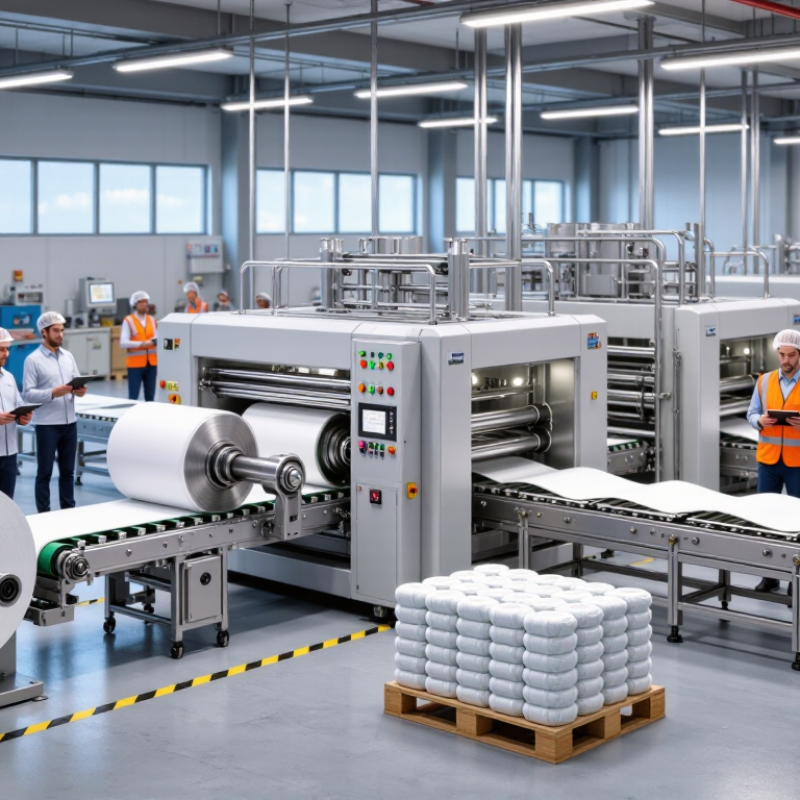
Automatic diaper lines are best classified by product type, not by a supplier’s headline speed. Baby diaper lines may produce tape-style or pant-style products, while adult diaper lines often need wider chassis and different absorbent-core dimensions. Training pants and incontinence products require their own forming, folding, and sealing arrangements. “Automatic” does not always mean hands-free. Some lines still require manual material splicing or package changes, so check the process description carefully.
Configuration affects both flexibility and rated output. Compare the number of size changes, web paths, core-forming modules, inspection points, and packing connections. A line rated at 600 pieces per minute may reach that figure only with a specific product size and stable materials. Changeovers, rejects, and brief stoppages can reduce saleable output. That matters. Ask how the figure was measured, and request a trial using your intended materials and sizes. A tidy specification sheet is useful, but it cannot answer every operating question.
Tips: Match the machine layout to your factory’s floor space and utility capacity. Ask for changeover times and maintenance access details. Keep a little doubt about any output estimate until you see a documented test under comparable conditions.
Compare Global Suppliers by Installed References, Export Reach, and Line Capacity
When comparing automatic diaper machine suppliers, look beyond brochure speed. Request three references from operating plants, including commissioning dates, product types, and recent output records. A line rated at 600 diapers per minute may achieve less when frequent size changes, material defects, or planned maintenance are included. Ask suppliers to define “capacity” and provide a factory acceptance test protocol using your target product specification.
Export reach matters after the machine leaves the factory. UNCTAD’s Review of Maritime Transport 2024 reports that shipping carries over 80% of world trade by volume, but this figure does not measure machinery delivery times. Compare suppliers’ shipment records to your region, spare-parts lead times, packaging plans, and installation support. Request redacted shipping documents or customer references where available. A broad export map looks reassuring, though it does not prove reliable local service.
Tips: Ask for net output, uptime assumptions, and changeover time in writing. Check whether quoted capacity includes reject products. Small details matter. Supplier figures are not always directly comparable; even careful buyers may miss that. Use the same test conditions for every offer.
Assess Material Control Using Nonwoven Basis Weight (ISO 9073-1)
For automatic diaper machines, basis weight is a practical first check on nonwoven consistency. ISO 9073-1:1989 provides a method for measuring mass per unit area, reported in grams per square metre. Take specimens from the left, centre, and right of the web, then repeat at the beginning, middle, and end of a roll. Use a calibrated balance and record the specimen area; otherwise, small cutting errors can distort the result. Small shifts matter. A lighter topsheet may feel less substantial, while uneven material can complicate feeding and sealing.
EDANA’s 2023 nonwoven statistics reported European production of about 2.9 million tonnes, down 5.6% from 2022. This broad market figure is not diaper-specific, but it underscores why buyers should verify each supplier’s material controls rather than rely on a general specification. Ask for recent test records, sampling locations, measurement equipment, and the agreed acceptance range. Compare laboratory results with the machine’s unwinding and tension data during a trial. A sensor reading alone is not proof. Nor is one good sample. In practice, teams sometimes overlook roll-edge variation; I would check it explicitly, even when the first trial looks clean.
Check Absorbent Product Performance with Whole-Product Testing (ISO 11948-1)
For global diaper-machine buyers, line speed matters, but absorbency must be checked on the finished product. ISO 11948-1:1996 measures the total absorption capacity of a complete absorbent article. The sample is immersed in test liquid, drained, and weighed. The result helps compare constructions and production lots. It does not measure leakage, rewet, or fluid acquisition speed. One number is not the whole story.
Smithers’ report, The Future of Global Nonwovens to 2028, identifies hygiene products as a major nonwoven end-use market, making consistent product checks commercially important. On a production line, small changes in core placement, sealing, or fluff distribution can affect test results. Buyers can request ISO 11948-1 results alongside checks for fit, leakage, and repeatability across batches. A careful supplier should explain the test conditions, sample count, and variation—not just show a high absorption figure. Still, lab immersion is not a baby’s real use. That gap deserves attention.
Top Automatic Diaper Machine Suppliers for Global Buyers - Check Absorbent Product Performance with Whole-Product Testing (ISO 11948-1)
| Evaluation dimension | Metric or evidence to record | Unit / format | Verification method | Buyer’s result |
| Whole-product absorption capacity | Liquid absorbed by the complete absorbent product under the selected test procedure | g/product | Test finished products using ISO 11948-1; report the procedure and test conditions with the result. | Enter measured result |
| Tested product identification | Product type, size, construction revision, and sample lot | Description / code | Record on the test report so absorption results can be linked to the exact product tested. | Enter details |
| Test method and report traceability | Standard edition, laboratory, test date, sample count, and reported results | Document reference | Request the complete test report. ISO 11948-1 is a whole-product test method; it does not by itself establish every aspect of in-use leakage performance. | Enter report reference |
| Machine output rate | Demonstrated production rate for the agreed product and operating conditions | Products/min | Verify during a witnessed factory or site acceptance test; record the product configuration and test duration. | Enter verified rate |
| Accepted product rate | Accepted finished products divided by total finished products produced during the agreed test | % | Define acceptance criteria before the test and document the inspection and counting method. | Enter measured rate |
| Product size range | Sizes and product designs the machine is specified to convert | Size labels / product codes | Check the machine specification and confirm each required format in a production trial. | Enter confirmed range |
| Changeover time | Elapsed time to change between agreed product formats and resume conforming production | min | Measure in a witnessed trial and specify which tasks, adjustments, and startup checks are included. | Enter measured time |
| Utility requirements | Electrical supply, compressed-air demand, and other utilities stated for the proposed configuration | V / Hz / kW; pressure and flow units as specified | Compare the supplier’s technical documentation with the intended factory’s available utilities. | Enter documented values |
| Safety and documentation | Risk assessment, operating and maintenance manuals, training plan, and applicable conformity documents | Document checklist | Review documentation against the destination market’s applicable legal and safety requirements. | Record status |
Note: Machine performance figures depend on product design, materials, configuration, and test conditions. Enter supplier-specific values only when supported by technical documentation or a witnessed acceptance test.
Benchmark Supplier Efficiency with OEE: Availability × Performance × Quality
When comparing automatic diaper machine suppliers, quoted output is only part of the picture. Use Overall Equipment Effectiveness (OEE) to assess how well a line converts planned production time into acceptable products. OEE equals Availability × Performance × Quality. Each factor reveals a different loss.
Availability shows how much scheduled time the machine actually runs. Check records for changeovers, web breaks, sensor faults, and waiting for materials.
Performance compares actual speed with the agreed operating rate; a line may run below target even without stopping.
Quality measures accepted diapers against total output, including defects such as poor seals, uneven elastic placement, or misplaced components.
Ask suppliers to show shift-level figures and explain how each number was calculated.
For a fair comparison, request a monitored trial using similar product specifications, materials, and shift conditions. Review the production log, not just a headline OEE score. A short demonstration can hide stoppages that appear during longer runs. Definitions matter, too: one supplier may count planned cleaning time differently from another. OEE is useful, but it does not capture every concern, such as maintenance access or operator training. No single score tells the whole story. A carefully documented test may still leave questions, and that uncertainty should be discussed rather than polished away.
