Top 10 Cargo Tie Down Straps for Global Buyers?
Choosing the right Cargo Tie Down Straps is less about finding the lowest price and more about matching the strap to the load. A pallet of boxed goods behaves differently from a stack of timber or machinery. Buyers should compare working load limit, strap width, webbing material, stitching, ratchet design, and end fittings. Small details matter. A hook that fits poorly can complicate loading, while unclear product labels make comparisons harder.
For a dependable baseline, the U.S. Federal Motor Carrier Safety Administration states: “Cargo must be firmly immobilized or secured.” This is a useful safety principle, not a universal substitute for local requirements or a product-specific assessment. Buyers should request clear specifications and test documentation, then confirm that the selected equipment suits the cargo, vehicle, and handling conditions. A clean-looking strap is not automatically a suitable one.
This Top 10 guide will compare options for global buyers across durability, usability, available configurations, and supplier transparency. It will also consider practical details: wet docks, sharp package edges, repeated ratchet use, and storage between shipments. No single strap fits every job. Even a strong product can disappoint when its rating, fittings, or length do not match the application. The rankings are a starting point; checking the actual product information remains essential.
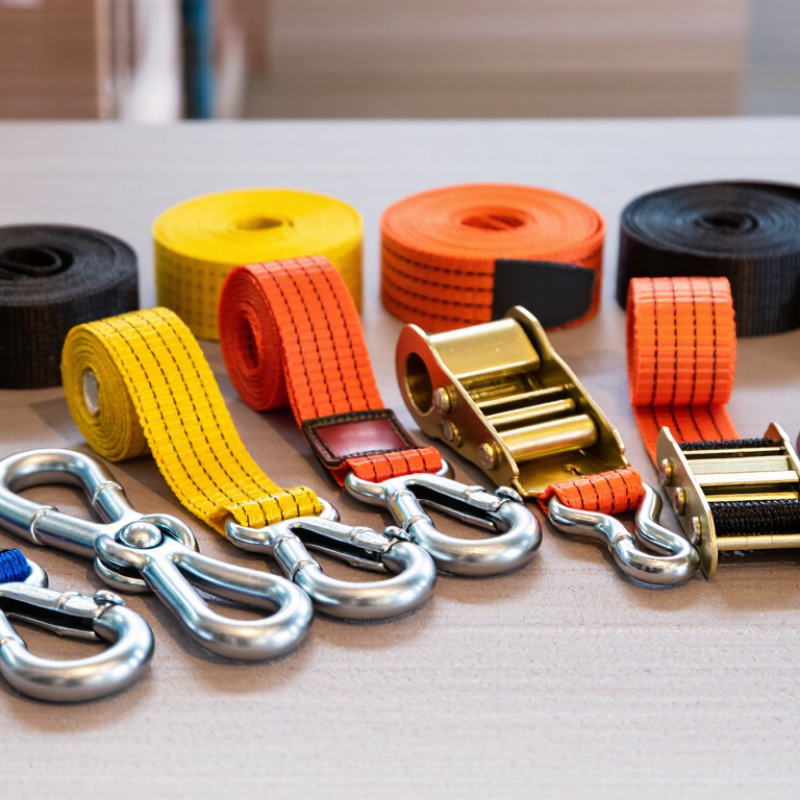
Cargo Tie-Down Strap Types and EN 12195-2 Lashing Capacity Ratings
Cargo tie-down straps come in several forms: ratchet straps for higher pretension, cam-buckle straps for lighter restraint, and endless loops for bundling or securing around suitable anchor points. The right choice depends on the load, anchor layout, and lashing method. A ratchet handle may feel reassuring, but excessive tension can damage cargo or strain weak anchor points.
For straps covered by EN 12195-2, check the sewn label for the lashing capacity (LC), standard hand force (SHF), and standard tension force (STF), where applicable. LC describes the strap’s rated lashing force; it is not the cargo’s permitted weight. STF indicates the tension produced by a ratchet under standardized conditions, which matters when using friction lashing. Numbers matter. They only help when the strap is used in the correct configuration.
Compare ratings and inspect the actual webbing, stitching, hooks, and ratchet before loading. Sharp edges need suitable protection, while wet or dirty webbing deserves closer attention. Never assume two straps provide twice the capacity; angles, anchor strength, and load movement affect the setup. Labels can be hard to read after repeated use. Replace damaged or unidentifiable straps, and verify the complete restraint arrangement against the cargo and equipment instructions. A good rating is useful, but it does not fix a poor lashing plan.
Top 10 Cargo Tie-Down Strap Ratings for Global Buyers
Example lashing capacity (LC) ratings for webbing lashing assemblies. These are comparison points, not a ranked list or ratings prescribed by EN 12195-2.
How to read the chart: LC is the lashing capacity marked for an assembly and is expressed in daN. Actual ratings depend on the complete assembly, including webbing, fittings, and configuration; check the product label and documentation.
Choosing a strap type: Ratchet straps provide tension through a ratchet mechanism; cam-buckle straps are commonly used where lower hand-applied tension is suitable; over-center buckle straps offer another manual-tension option. Select by the load, lashing method, and verified assembly rating—not by strap width alone. LC is not the same as STF (standard tension force).
How FMCSA’s 0.8g Forward and 0.5g Sideways Forces Guide Strap Selection
For global buyers, FMCSA’s 0.8g forward and 0.5g sideways criteria offer a useful starting point for evaluating cargo securement. Under U.S. rules, the complete system must resist specified forces during transport. These figures are not instructions to select one strap rated at 80% or 50% of the load. Strap working load limits, anchor points, blocking, and friction all affect performance.
Consider a palletized machine weighing 1,000 kilograms. Sudden braking can push it forward with a force comparable to 800 kilograms of weight; a turn can create sideways force comparable to 500 kilograms. Real loads vary. A tall machine may tip, while a smooth pallet may slide across a damp deck. The same strap arrangement will not suit both. Check the strap’s working load limit label, account for tie-down direction, and protect webbing from sharp corners. Small details matter.
A tidy calculation can still miss a weak anchor or loose strap. That is worth a second look. Buyers should assess the whole securement setup, not just the number printed on a strap. Verify that the straps are undamaged, properly tensioned, and compatible with the cargo and vehicle. If the load shifts during a short test stop, the plan needs adjustment before the trip continues.
Webbing, Ratchets, and Hooks: Comparing Strap Materials and Load Ratings
For global buyers, compare the complete tie-down assembly, not just its webbing. Polyester webbing is commonly selected for its relatively low stretch and resistance to moisture. Still, sharp pallet edges can cut fibers quickly. Add edge protection where straps cross metal corners. Small details matter.
Ratchets create tension; they do not raise a strap’s rating. Hooks must fit secure anchor points without twisting or side-loading. The U.S. Federal Motor Carrier Safety Administration’s cargo-securement rule, 49 CFR 393.106(d), sets aggregate tiedown working load limit at no less than half the cargo’s weight. Under 49 CFR 393.108, an assembly’s rating is constrained by its lowest-rated component. Check the labels on webbing, ratchet, and hooks together. A strong-looking handle proves little. The Web Sling & Tie Down Association’s WSTDA-T-1 standard is another useful reference for web tie-down construction and testing. Ratings and labeling practices can vary by supplier, so request test documentation and inspect stitching, cuts, corrosion, and hook deformation before use. A tidy spec sheet helps, but it cannot reveal every flaw in a strap after hard service.
Top 10 Cargo Tie-Down Straps Compared by LC, STF, and Transport Use
A useful comparison of ten cargo tie-down straps starts with LC and STF, not appearance. LC indicates a strap’s lashing capacity; STF describes the tension created by a ratchet during a top-over tie-down. They are not interchangeable. Higher LC can suit direct restraint on a heavy pallet, while adequate STF helps secure a load pressed down onto a truck bed. For lighter cartons, a narrower strap may be easier to position, but only if its marked capacity fits the load plan. Transport conditions matter: a short delivery over smooth roads differs from a long trip with repeated braking and vibration.
Tips: Read the sewn label before use. Check the strap, ratchet, and hooks for cuts, distortion, or corrosion. Keep webbing flat and avoid sharp edges; use edge protection where needed. Small details matter.
When comparing options, look for clear LC and STF markings, compatible end fittings, and webbing suited to the load’s shape. A flat hook may fit a designated anchor point better than a wire hook; neither is automatically right for every vehicle. Do not infer capacity from strap width or color alone. Recheck tension after loading, especially if cartons settle or the route is rough. One practical limitation: published ratings cannot account for every anchor point or loading pattern, so the full restraint setup needs careful review.
Global Buyer Checks: EN 12195-2 Labels, Inspections, and Safe Use
Top 10 Cargo Tie Down Straps for Global Buyers?
Global Buyer Checks: EN 12195-2 Labels, Inspections, and Safe Use
A strap’s label is more than a product detail. Under EN 12195-2, check its lashing capacity (LC), standard tension force (STF), hand force, length, and material identification. LC describes the restraint capacity; STF indicates tension applied with the ratchet. They are not interchangeable. Read the figures against the load and securing plan, rather than choosing by strap width alone.
Small detail. Big difference.
The European Commission’s European Best Practice Guidelines on Cargo Securing for Road Transport cite estimates that inadequate load securing is involved in about 25% of truck accidents. That figure makes routine checks worth the time. Before each use, inspect the webbing for cuts, fraying, chemical damage, or heat damage. Check stitching, ratchet teeth, hooks, and connecting points, too.
A faded or unreadable label is a reason to set the strap aside, not guess its rating. I have seen tidy-looking webbing conceal damage near the seam; appearance can mislead.
Never knot a strap or exceed its marked capacity. Secure the load, then recheck tension after the vehicle has travelled a short distance.
